
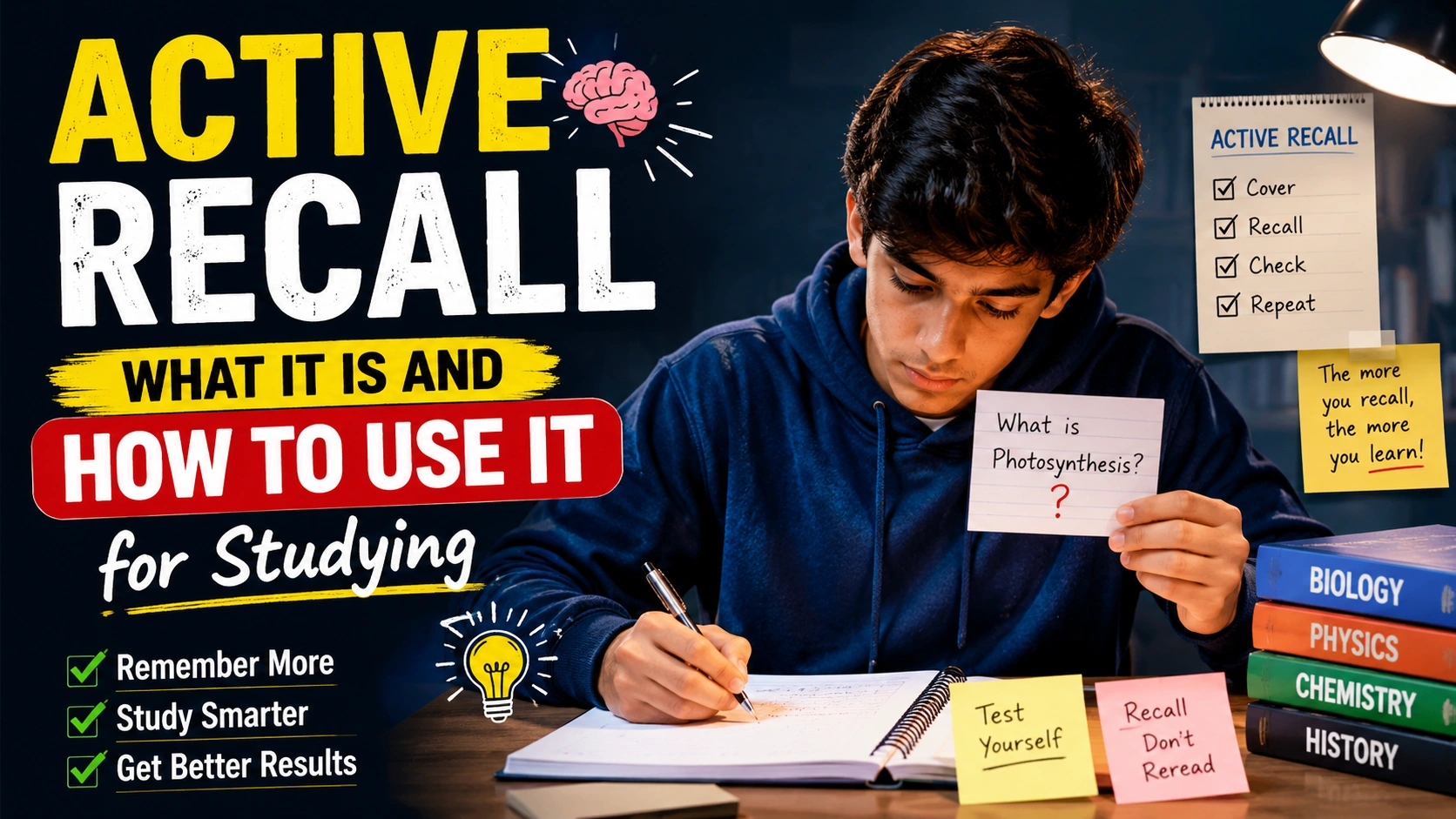
Studying can sometimes feel really confusing. You can read the same chapter two or three times, underline many lines, and even make neat notes, but when someone asks you a question, your mind suddenly goes blank. I have had this feeling too, and honestly, it is pretty annoying.
That is where active recall can help.
Active recall is a simple study method where you do not just read information again and again. Instead, you try to remember the information without looking at your book or notes. You ask yourself questions, answer them from memory, and then check if your answer is correct.
It sounds simple, but there is a good reason why this method is useful. Research on learning has found that practicing retrieval can improve how well we remember information over time.
“Don’t just read it. Try to remember it.”
That one idea is basically the heart of active recall.
What Is Active Recall?
Active recall means trying to bring information back from your memory instead of simply looking at it.
For example, suppose you are studying Biology and your topic is photosynthesis.
You could read your textbook several times and think, “Yeah, I understand this.”
But with active recall, you close the book and ask yourself:
“What is photosynthesis?”
Then you try to answer without looking.
Maybe you remember that plants use light energy to help make food. You write down everything you remember. After that, you open your book and check your answer.
If you forgot something, that is completely okay.
Actually, finding what you forgot is one of the useful parts of active recall.
The idea is not to prove that you already know everything. The idea is to find the things you still need to learn.
Active recall is also called retrieval practice in learning research. Studies have found that actively retrieving information can support long-term retention better than simply studying the same information again.
Why Does Active Recall Work?
Our brains are not like notebooks where information stays forever after we read it once.
We forget things.
That is normal.
When you read something, you may feel like you know it because the words look familiar. But recognizing something is not always the same as being able to remember it by yourself.
For example, if I show you the answer to a question, you might say:
“Oh yeah! I remember that.”
But if I hide the answer and ask you the question, you might struggle.
This is the difference between recognizing information and recalling information.
Active recall makes your brain actually search for the answer.
Research reviews on retrieval practice show that practicing retrieval can help slow forgetting and improve later remembering.
So instead of spending all your study time putting information into your brain, you also spend time pulling information out.
That is what makes active recall different.
Active Recall vs. Reading Again
Let’s say you have a chapter that is 20 pages long.
You read it once.
Then you read it again.
Then maybe you highlight important lines.
It can feel like you are studying a lot.
But you might still forget some information later.
Now imagine doing this instead:
- Read a small section.
- Close your book.
- Ask yourself questions.
- Answer without looking.
- Check your answers.
- Study the things you missed.
- Try again later.
This makes your brain work harder.
And yes, active recall can feel harder than reading.
That does not automatically mean you are doing something wrong.
In fact, the effort of trying to remember can be an important part of learning.
“Easy studying is not always the best studying.”
This is one reason active recall is worth trying.
How to Use Active Recall While Studying
The good thing about active recall is that you do not need expensive equipment.
You can use a notebook, some paper, flashcards, or even your own voice.
Here are some easy methods.
1. Close the Book and Explain the Topic
This is probably the easiest way to start.
Read a small section of your textbook.
Then close the book.
Now explain the topic in your own words.
You can write it down or say it quietly.
For example, if you are studying the water cycle, ask yourself:
“What happens during the water cycle?”
Try to explain evaporation, condensation, precipitation, and collection without looking.
Then check your textbook.
If you missed something, go back and learn that part.
This method is especially useful because you quickly find the parts you do not understand.
2. Ask Yourself Questions
Turn your notes into questions.
Instead of writing:
“Earth rotates on its axis.”
Write:
“What does Earth rotate on?”
Instead of:
“Plants need sunlight, water and carbon dioxide for photosynthesis.”
Ask:
“What things do plants need for photosynthesis?”
Then answer without checking your notes.
You can make questions before you start studying or while making notes.
This is a very simple way to bring active recall into your normal study routine.
3. Use Flashcards
Flashcards are another popular way to practice active recall.
One side can have the question.
The other side can have the answer.
For example:
Front: What is the largest planet in our solar system?
Back: Jupiter.
Look at the question first and try to answer it before turning the card over.
Do not turn the card over immediately.
Give your brain a few seconds to search for the answer.
If you remember it, great.
If you don’t, look at the answer, learn it, and try again later.
Flashcards can be physical cards or digital cards.
Just remember that the important part is trying to answer before seeing the answer.
4. Use the Blank Page Method
This is one of my favorite ways to use active recall.
Take a blank piece of paper.
Write the name of the topic at the top.
Then close your textbook and write down everything you remember.
Do not worry about making it look perfect.
Just write.
For example:
Topic: The Human Digestive System
You might remember:
- Mouth
- Oesophagus
- Stomach
- Small intestine
- Large intestine
- Digestion
- Absorption
After that, open your book and compare your list.
You may notice that you forgot some important points.
Those missing points become your next study targets.
This is sometimes called a “blank page” or “free recall” approach. Research has examined free-recall activities as one form of retrieval practice.
5. Teach Someone Else
Another fun way to practice active recall is to pretend you are the teacher.
You can explain the topic to a friend, family member, or even yourself.
Imagine someone asks:
“Why does this happen?”
Try to answer.
Then ask yourself another question.
If you cannot explain something in simple words, that can be a sign that you need to review it.
You do not need an actual student sitting in front of you.
You can sit at your desk and explain the topic out loud.
I sometimes think this is more interesting than just reading notes because it feels like you are actually doing something.
6. Make Your Own Mini Test
Before an exam, make a small test for yourself.
Write 10 to 20 questions about the chapter.
Put your notes away.
Then answer the questions.
Do not check the answer after every question. Try to finish the whole mini test first.
Then check your answers.
Mark the questions you got wrong.
Those questions should get extra attention.
This also helps you understand what you actually know instead of simply feeling familiar with the chapter.
7. Use Practice Questions
If your textbook has questions at the end of a chapter, use them.
But there is one important rule:
Try to answer before looking at the answer.
Practice quizzes are one type of retrieval practice, and research has found benefits from practice quizzing for retention.
If you get a question wrong, do not feel bad.
That question has just shown you something you need to work on.
Think of wrong answers as information about what to study next.
How to Combine Active Recall With Spaced Study
Active recall and spaced study are related, but they are not exactly the same thing.
Active recall is about how you study.
Spacing is about when you study.
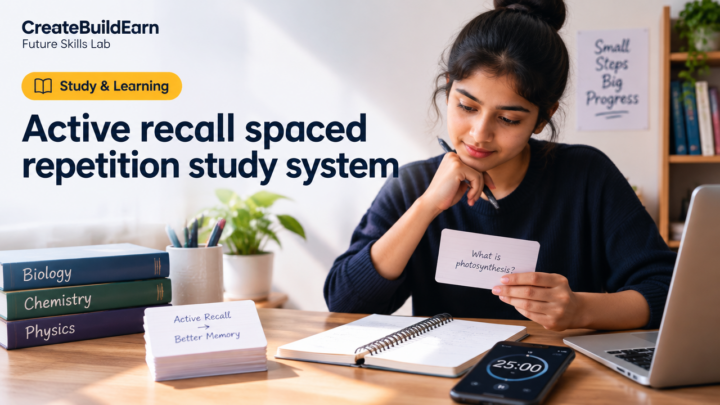
For example, you could study a topic on Monday, test yourself on Wednesday, test yourself again on Saturday, and then review it again later.
This gives your brain repeated chances to retrieve the information over time.
Research reviews support both retrieval practice and spacing as useful learning strategies.
You can make a simple schedule like this:
| Day | What to Do |
|---|---|
| Monday | Learn the topic and do active recall |
| Tuesday | Quick recall for 5–10 minutes |
| Thursday | Test yourself again |
| Saturday | Do a mini test |
| Next week | Recall the topic again |
The exact schedule does not have to be perfect.
The important thing is to come back to the information instead of studying it only once.
How Active Recall Can Help in Different Subjects
Active recall is not only for Biology or Science.
You can use it for many subjects.
Mathematics
Math needs practice, so active recall can be used by trying to remember formulas and deciding which method to use for a problem.
For example:
“What is the formula for the area of a circle?”
Try to remember it before checking your notes.
Then solve a problem without copying an example.
Science
Ask yourself questions about definitions, processes, diagrams, experiments, and important facts.
For example:
“What are the steps in this process?”
Then explain the steps without looking.
History
History can have many dates, people, places, and events.
Make questions such as:
“What happened during this event?”
“Why was this event important?”
“What happened before and after it?”
Try answering in your own words.
Geography
You can recall definitions, locations, processes, and causes.
Try drawing a map or diagram from memory.
Then compare it with your textbook.
Languages
You can use active recall for vocabulary, grammar rules, meanings, and sentence patterns.
Look at a word and try to remember its meaning.
Or look at the meaning and try to remember the word.
Common Mistakes With Active Recall
Active recall is simple, but there are some mistakes students can make.
Mistake 1: Looking at the Answer Too Quickly
If you look at the answer after two seconds, you are not giving your brain much time to retrieve it.
Try thinking for a little while first.
Mistake 2: Only Studying What You Already Know
Sometimes students keep answering easy questions because it feels good.
But you should also practice the difficult ones.
If you keep getting a question wrong, give it more attention.
Mistake 3: Never Checking Your Answers
This is a big one.
You need to check your answers after recalling.
Otherwise, you may keep remembering something incorrectly.
Active recall works best when you use feedback to correct mistakes.
Mistake 4: Trying to Memorize Everything at Once
Do not take an entire textbook and try to recall every single sentence.
Start with smaller sections.
Study one topic, recall it, check it, and move on.
Mistake 5: Thinking Wrong Answers Mean You Are Bad at Studying
They don’t.
A wrong answer can actually be useful because it shows you where your weak points are.
“A mistake during practice is a clue, not a failure.”
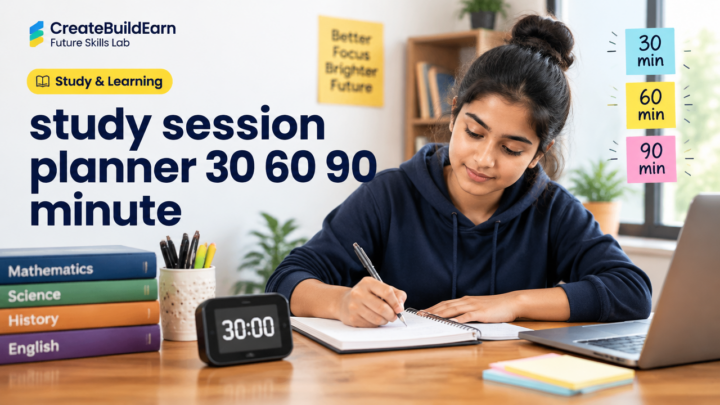
A Simple 30-Minute Active Recall Study Session
If you are new to active recall, try this simple routine.
| Time | Task |
|---|---|
| 0–10 minutes | Read and understand one small topic |
| 10–15 minutes | Close the book and recall what you learned |
| 15–20 minutes | Check your answers |
| 20–25 minutes | Review the parts you forgot |
| 25–30 minutes | Test yourself again |
You do not have to study for hours before using active recall.
Even a short session can help you practice retrieving information.
The main goal is to make your brain do the remembering, not just watch your eyes move across a page.
Active Recall Does Not Mean You Should Never Read
This is important.
You should not stop reading your textbook completely.
You first need to learn and understand new information.
Then use active recall to see what you can remember.
Think of it like this:
Learn → Close the book → Recall → Check → Fix mistakes → Recall again
Reading helps you understand new information.
Active recall helps you practice bringing that information back.
Both can have a place in studying.
What If I Cannot Remember Anything?
Do not panic.
This happens.
If you close your book and remember almost nothing, open it again and study a smaller section.
Then close it.
Try again.
You can also use small hints.
For example, if you are trying to remember four steps, write only the first letter of each step as a clue.
As you get better, remove the clues.
The goal is not to make studying frustrating.
The goal is to gradually make your brain better at retrieving the information.
Important Information About Active Recall
| Point | Simple Explanation |
|---|---|
| Main idea | Remember information without looking at the answer |
| Also called | Retrieval practice |
| Best tool | Questions, flashcards, blank paper, practice tests |
| First step | Learn and understand the topic |
| Next step | Close your notes and recall |
| After recalling | Check your answer |
| If you make mistakes | Review the missing information |
| For better long-term learning | Combine recall with spaced study |
| What to avoid | Only rereading and assuming you know everything |
| Main goal | Make remembering easier over time |
Research reviews describe retrieval practice as a well-supported learning strategy, and its benefits have been studied across different types of material and learners.
My Simple Active Recall Routine
If I had to make active recall as simple as possible, I would use these five steps:
Step 1: Learn one small topic.
Step 2: Close the book.
Step 3: Ask yourself questions.
Step 4: Write or say the answers from memory.
Step 5: Check your answers and repeat the difficult parts later.
That’s it.
You don’t need a fancy desk.
You don’t need a huge pile of stationery.
You don’t need to study all night.
You just need to practice remembering.
Frequently Asked Questions
1. What is active recall in simple words?
Active recall means trying to remember something without looking at your notes or textbook. You can use questions, flashcards, practice tests, or a blank page to do it.
2. Is active recall better than reading?
Active recall and reading do different jobs. Reading can help you learn and understand new material, while retrieval practice helps you practice remembering it. Research has found that retrieval practice can improve long-term retention compared with simply restudying information.
3. Can I use active recall for every subject?
You can use active recall for many subjects, including Science, History, Geography, languages, and parts of Mathematics. The questions and practice method may change depending on the subject.
4. How long should I do active recall?
There is no single perfect time. You can start with 5–10 minutes for one topic and slowly increase it. Short, focused sessions can be easier to fit into a normal study day.
5. What should I do when I get an answer wrong?
Check the correct answer, understand what you missed, and then try recalling it again later. Getting something wrong during practice can help you find the topics that need more study.
Conclusion
Studying is not only about spending more hours with a book.
Sometimes it is about changing how you study.
Active recall is one simple way to make your study time more useful. Instead of reading the same notes again and again, you close the book and make your brain search for the information.
You can use flashcards, questions, practice tests, a blank page, or simply explain a topic out loud.
At first, it may feel difficult.
You might forget things.
You might get questions wrong.
That is okay.
Those moments show you what you need to learn next.
“Don’t measure your study by how many pages you read. Measure it by how much you can remember without looking.”
Start small. Pick one topic today, close your book, and try to recall everything you can.
You may be surprised by how much more active your studying feels.
And remember: active recall is not about being perfect. It is about practicing remembering.
Want a professional website designed for your business or blog?
Visit eDigitalized for website design and development services.
Need help or support?
Visit our Contact Us page and get in touch with us.
Want to become a blogger and start your own blog?
Visit WP Bazaar for blogging resources, tools, and helpful guides.

How this guide was prepared
This guide is prepared for everyday readers using practical research, usability checks and editorial review. Product or tool-specific claims should be verified against current official documentation when needed.
How did you like this article?
Your feedback helps us make our guides more useful.



Join the Discussion
Join the conversation and share a useful tip, question or experience.