
Quick Start
What you will learn/build: A simple, reusable AI content research checklist that helps you collect information, verify sources, and reduce misinformation.
Skill level: Beginner — no coding required; basic web skills and critical thinking.
Time needed: 60–120 minutes to set up and try the mini-project.
What you need: A web browser, access to an AI assistant (optional), access to search engines, a note tool (Google Docs, Notion, or a spreadsheet), and basic understanding of source types.
Why this project matters
AI tools can speed up research, but they can also repeat mistakes or return unsupported claims. A checklist helps you guide AI output, check sources, and protect privacy. This project teaches safe AI use and builds a repeatable research habit you can use for blog posts, school work, or creator notes.
Prerequisites
- Basic web search experience (Google, Bing or DuckDuckGo).
- Comfort copying links and reading short articles.
- Awareness of personal data—do not upload private documents to public AI services without checking privacy terms. See our Student AI Privacy Checklist for details.
What is an AI content research checklist?
It’s a step-by-step list you follow when gathering information with and without AI. It combines specific questions for the AI, steps to verify sources, and a quick privacy review. The checklist reduces bias and improves reliability of your notes.
Step-by-step path to build your checklist
- Define the topic and intent. Write one clear research question. Example: “What are three beginner-friendly benefits of urban gardening in apartment balconies?”
- Ask AI for a draft outline (optional). Use a focused prompt. Keep a copy of sources AI lists and mark which are direct links vs. paraphrases. Use the Prompt Writing Formula as needed: Prompt Writing Formula.
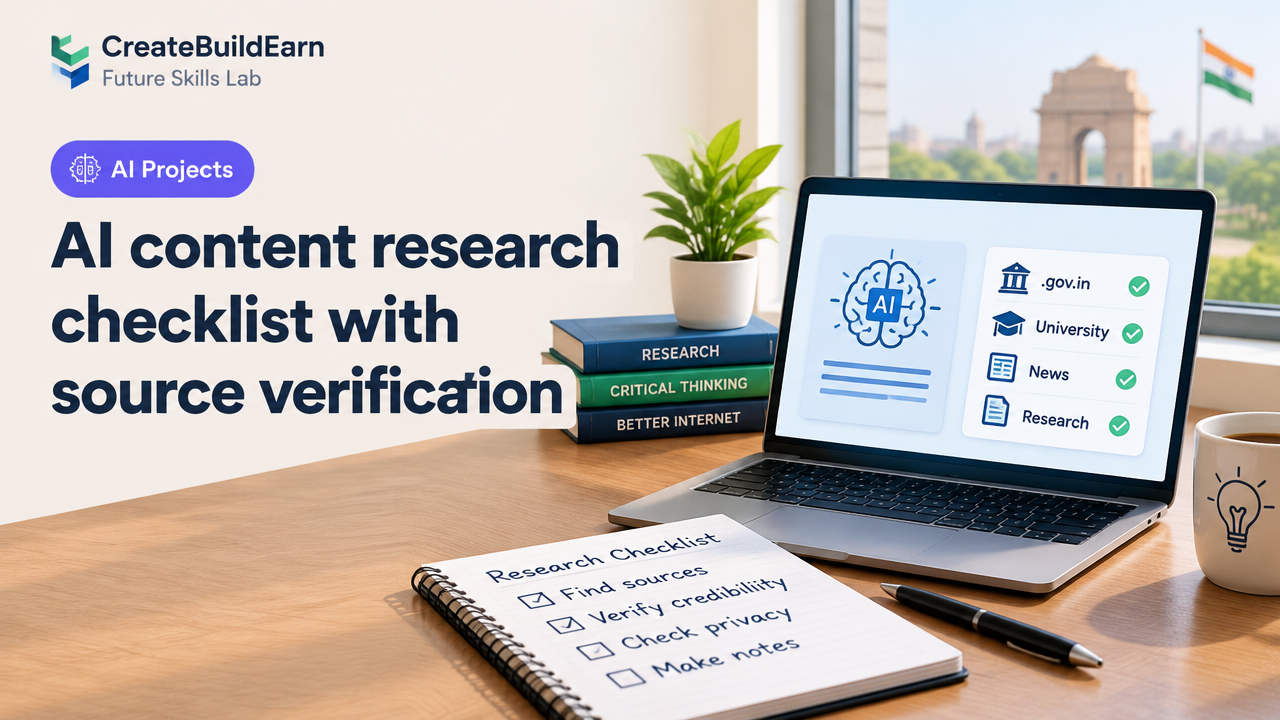
- Collect candidate sources. Search for government pages (.gov or .gov.in), university pages, reputable news outlets, and peer-reviewed studies. Save URLs and short notes.
- Verify each source with the checklist below. Check author, publication date, domain, evidence type, and whether other trusted sources agree.
- Synthesize carefully. Combine verified points into your notes. Flag any uncertain items to research further.
- Privacy and compliance check. Remove any personal data you might have used. If you’re uploading text to an AI tool, check its data retention policy.
Practical checklist table
| Step | What to check | Why it matters | Quick example |
|---|---|---|---|
| 1. Domain & publisher | Is it .gov/.edu or a known publisher? | Trusted domains usually have higher editorial standards. | gov.in page on urban horticulture |
| 2. Author & credentials | Who wrote it? Are they an expert? | Experts reduce chance of inaccurate claims. | University extension article by an agronomy professor |
| 3. Date & version | Is it recent or updated? | Old data may be obsolete. | Published 2023 vs. 2005 |
| 4. Evidence type | Study, data, or opinion piece? | Studies and data are stronger than opinions. | Peer-reviewed study vs blog post |
| 5. Cross-check | Do 2–3 other reputable sources agree? | Agreement increases confidence. | Multiple university guides list similar benefits |
Worked example: Verifying a claim
Claim: “Urban balcony gardens reduce household energy costs.” Here’s how to verify quickly:
- Search for the claim in quotes and without quotes in a search engine.
- Find sources: note any government energy efficiency pages, university studies, or NGO reports.
- Check domain and date. Prefer recent studies or official guidance.
- Read the study’s methods: does it measure energy savings directly, or model them?
- Cross-check: do other sources report similar savings or do they say benefits are primarily non-energy (like air quality)?
Outcome: If you find a peer-reviewed study showing measured savings, include the exact figure and link. If only models exist, state that the evidence is model-based and note assumptions. If no reliable sources support the claim, mark it as unsupported and do not assert it as fact.
Try It Now / Mini Project
Mini project: Use the checklist to research and verify three supporting facts for a short blog paragraph (3–5 sentences) on any topic.
- Pick a clear topic (example: “Benefits of container composting in small flats”).
- Use your checklist to find one government or university page, one news report, and one study or NGO note. Save URLs and short notes.
- Write one paragraph that includes only the verified facts, with links to the sources. Mark anything that remains uncertain with a note.
Timebox: 45–60 minutes.
Checkpoint / Self-review
After completing the mini project, ask yourself:
- Did I use at least one trustworthy domain (gov, edu, or known publisher)?
- Did I check author and date for each source?
- Did I cross-check claims with 2–3 sources when possible?
- Did I avoid copying private data into the AI tool? (If I used AI, did I check its privacy policy?)
Common mistakes to avoid
- Accepting AI output without source checks. AI can produce confident-sounding but unsupported claims.
- Using only a single news article as evidence for a general claim.
- Uploading personal or exam content to public AI tools without checking privacy terms.
- Mixing opinion and fact without labeling which is which.
Review checklist before publishing
- Source links saved and accessible.
- All factual claims have at least one verified source cited.
- Any uncertain claims are clearly labeled as such.
- Privacy check done for any AI-assisted steps.
- Short bibliography or references list added to your draft.
Next practice and growth steps
Once comfortable with the checklist, try:
- Turning your notes into a small blog post and following our Blogging SEO and Digital Growth path.
- Combining this checklist with a simple AI summarization prompt; always verify the summary against sources.
- Learning better prompts: use the Prompt Writing Formula to get more precise AI help.
Related internal resources
- Prompt Writing Formula: Role, Context, Task, Constraints
- Student AI Privacy Checklist Before Uploading Personal Information
- Build an AI Assisted Study Quiz Project: A Responsible Beginner Guide
- SEO Search Intent and Content Usefulness
Frequently Asked Questions
Do I need an AI tool to use this checklist?
No. The checklist works for manual web research. AI can speed up steps but never replaces source verification.
How do I know a source is trustworthy?
Trust comes from domain type (.gov, .edu), clear authorship, up-to-date date, references, and agreement with other reputable sources. Use the checklist table to rate each source.
Is it safe to paste articles into AI tools for summarizing?
Only after checking the AI tool’s privacy and data retention policy. For sensitive or private content, avoid uploading or use local/offline tools. See our Student AI Privacy Checklist for more guidance.
What if sources disagree?
Compare evidence quality: peer-reviewed studies and official reports rank higher than opinion pieces. If disagreement remains, present both views and note uncertainty.
How many sources do I need for one claim?
Aim for at least two independent reputable sources for important claims. For trivial facts, one solid authoritative source may suffice.
Can I use social media posts as sources?
Only with caution. Use social posts to find leads but verify facts with authoritative sources before citing them.
Where should I keep my checklist?
Use a reusable note: a Google Doc, Notion template, or a spreadsheet so you can copy it for each research task.
Conclusion and next skill to learn
This project gives you a practical habit: use focused prompts or searches, collect candidate sources, verify using the checklist, and synthesize responsibly. Next, learn better prompt design to get more reliable AI output—start with the Prompt Writing Formula and practice safe AI use while you grow your creator workflow.
Learn it by building something
Use the guide as a learning checklist, build a small version yourself, test it, explain what you learned and then improve the project.
How this guide was prepared
This guide is prepared for everyday readers using practical research, usability checks and editorial review. Product or tool-specific claims should be verified against current official documentation when needed.
How did you like this article?
Your feedback helps us make our guides more useful.

Join the Discussion
Join the conversation and share a useful tip, question or experience.