
Quick Start
What you will learn/build: Understand break-even units, use the formula, and calculate how many items a small classroom business must sell to cover costs.
Skill level: Beginner (no accounting background needed)
Time needed: 20–45 minutes (including the mini project)
What you need: A pen and paper or a spreadsheet (Google Sheets or Excel), a calculator, and rough cost estimates for a simple product.
What are break-even units?
Break-even units are the number of items you must sell so that total revenue equals total costs. At this point your profit is zero — you cover all fixed and variable costs but do not make profit yet. This is a basic tool for pricing, planning and deciding whether a small project is feasible.
Why break-even units matter for small projects and students
For classroom businesses, market stalls, or simple service ideas, break-even units help you:
- Know the minimum sales needed to avoid a loss.
- Test different prices or cost-saving ideas quickly.
- Build a simple plan to show to classmates, teachers or parents.
Prerequisites — what to know before you start
- Fixed costs: expenses that do not change with each unit (e.g., signboard, basic stand, initial supplies).
- Variable cost per unit: cost that varies with each item (materials, packaging).
- Selling price per unit: amount you charge customers per item.
Step-by-step method to calculate break-even units
- List fixed costs (sum of one-time and period costs you must pay regardless of sales).
- Calculate the variable cost per unit (materials, per-item packaging, direct labour if paid per piece).
- Choose a selling price per unit (realistic market price).
- Compute contribution margin per unit = Price − Variable cost per unit.
- If contribution margin > 0, compute break-even units = Fixed costs ÷ Contribution margin. Round up to the next whole unit.
Formula (short):
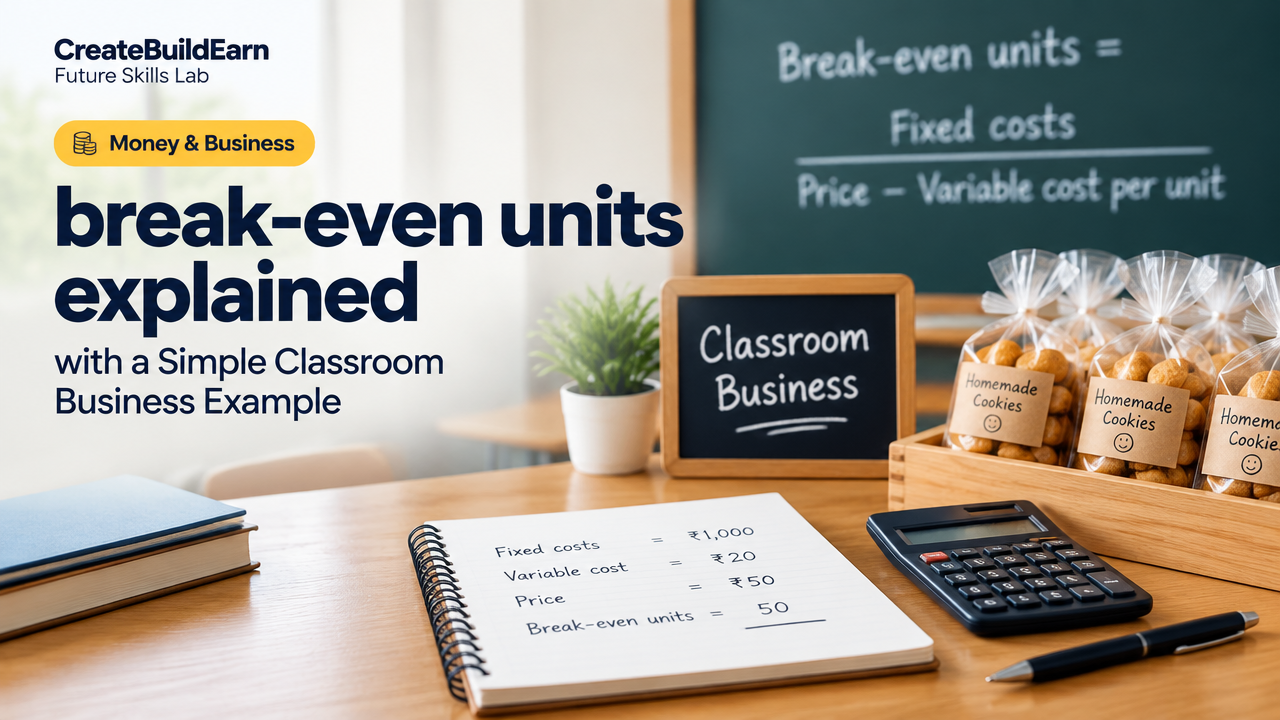
break-even units = Fixed costs / (Price − Variable cost per unit)
Worked classroom example (simple, in INR)
Scenario: A class decides to make and sell handmade bookmarks at a school fair.
| Item | Amount (INR) |
|---|---|
| Fixed costs (poster, laminator sheet pack, small stand) | 1,200 |
| Variable cost per bookmark (paper, ribbon, glue) | 15 |
| Planned selling price per bookmark | 50 |
Step calculation:
- Contribution margin per unit = 50 − 15 = ₹35
- Break-even units = 1,200 ÷ 35 = 34.285… → round up to 35 bookmarks
Interpretation: The class must sell 35 bookmarks at ₹50 each to cover all costs. Selling 36 or more gives a small profit (e.g., 36th bookmark adds ₹35 to profit).
Quick sensitivity check (try another price)
If they tried selling at ₹40 instead:
- Contribution = 40 − 15 = ₹25
- Break-even = 1200 ÷ 25 = 48 bookmarks
This shows how price and costs affect the number of items you must sell.
Practical checklist to plan your break-even (table)
| Step | Action | Completed |
|---|---|---|
| 1 | List all fixed costs and estimate their INR amount | [ ] |
| 2 | List materials and calculate variable cost per unit | [ ] |
| 3 | Decide realistic selling price based on peers or market | [ ] |
| 4 | Compute contribution margin and break-even units | [ ] |
| 5 | Run a sensitivity check for 2 price or cost scenarios | [ ] |
| 6 | Make a simple plan to reach the break-even sales in time | [ ] |
Try It Now / Mini Project
Mini project: Run a one-day classroom stall selling a simple product (bookmarks, cookies or lemonade). Use real or estimated numbers and answer these:
- What are your fixed costs? (₹)
- What is your variable cost per item? (₹)
- What will you charge per item? (₹)
- Compute break-even units. How many do you need to sell in one day?
Deliverable: A one-page plan with your calculations, and a short note on how you will reach that number (e.g., selling at recess, posters, 3 sellers).
Checkpoint — quick self-review
Answer these to check your understanding:
- Can your contribution margin be zero or negative? What does that mean?
- If fixed costs double, how does break-even change?
- Which is easier to change quickly: price or variable cost per unit?
Simple answers: A zero or negative contribution means you cannot break even at that price — you must raise price or lower variable cost. If fixed costs double, break-even units double. Variable costs often are easier to reduce by bulk buying or simpler packaging.
Common mistakes to avoid
- Forgetting some fixed costs (transport, small fees, or packaging tools).
- Using average price when you should expect a mix of discounted and full-price sales.
- Not rounding up break-even units — partial units are not sellable.
- Ignoring time value or labour: if you pay helpers by hour, include it in your costs.
- Mistaking contribution margin percentage for absolute rupee margin — use rupees for units calculation.
Review checklist before you run the mini project
- All fixed and variable costs listed and summed (in INR)
- Price set and tested against peers
- Break-even units calculated and rounded up
- Simple plan to reach sales target (time, people, marketing)
- Safety and school rules checked (no age or rule violations)
Next practice / roadmap
After you finish this mini project, try these next steps:
- Practice pricing services: read Pricing Digital Services: Scope, Time, Costs, Revisions and Value.
- Turn a classroom skill into a simple freelance offering: Turn a Skill into a Freelance Service Ethically.
- Create a small portfolio project that shows your plan and results: Beginner Portfolio Before Client Work.
- Map your learning goals with the Future Skills Roadmap for communication and problem-solving practice.
Frequently Asked Questions
What if my contribution margin is very small?
If contribution margin (Price − Variable cost) is tiny, you will need many units to break even. Options: increase price, reduce variable cost, or reduce fixed costs. Also consider whether the business fits the context — a very small margin may not be worth the effort.
Do I include labour cost in fixed or variable costs?
Include direct labour that varies with each unit (paid per item) as variable cost. Include salaries or wages that you must pay regardless of how many units sold (fixed). For student projects, value your time but clearly label whether it is paid or unpaid.
Should I round break-even units up or down?
Always round up to the next whole unit because you cannot sell a fraction of a physical item. Rounding down may leave you short and still at a loss.
Does break-even consider profit targets?
Basic break-even finds the point of zero profit. To include profit, add your desired profit to fixed costs or calculate units for target profit: units = (Fixed costs + Target profit) ÷ Contribution margin.
How do taxes or school fees affect the calculation?
Include any taxes or mandatory fees in your costs — either as fixed costs or variable per unit if charged per sale. For student projects, check school rules first and include any applicable charges.
Can I use a spreadsheet for multiple scenarios?
Yes. Spreadsheets are ideal: put fixed costs in one cell, variable cost and price in others, and compute break-even units as a formula. Then change price or costs to see instant results.
Is break-even the same as cash-flow break-even?
No. Break-even units focus on covering costs for a product. Cash-flow break-even includes timing of cash flows — when you pay and when you receive money. For simple classroom projects, product break-even is usually enough.
Conclusion — what to learn next
Calculating break-even units is a small, powerful skill that helps you plan any simple business or school project. Next, learn how to price services and offer value — check the linked pricing guide above. Practice with a mini project, record results, and use those numbers to improve your next plan.
Safety and responsible use note: If you use AI tools to help with planning, verify calculations and avoid sharing personal or financial details publicly. For any project involving minors, follow school rules and parental consent requirements.
Learn it by building something
Use the guide as a learning checklist, build a small version yourself, test it, explain what you learned and then improve the project.
How this guide was prepared
This guide is prepared for everyday readers using practical research, usability checks and editorial review. Product or tool-specific claims should be verified against current official documentation when needed.
How did you like this article?
Your feedback helps us make our guides more useful.



Join the Discussion
Join the conversation and share a useful tip, question or experience.