
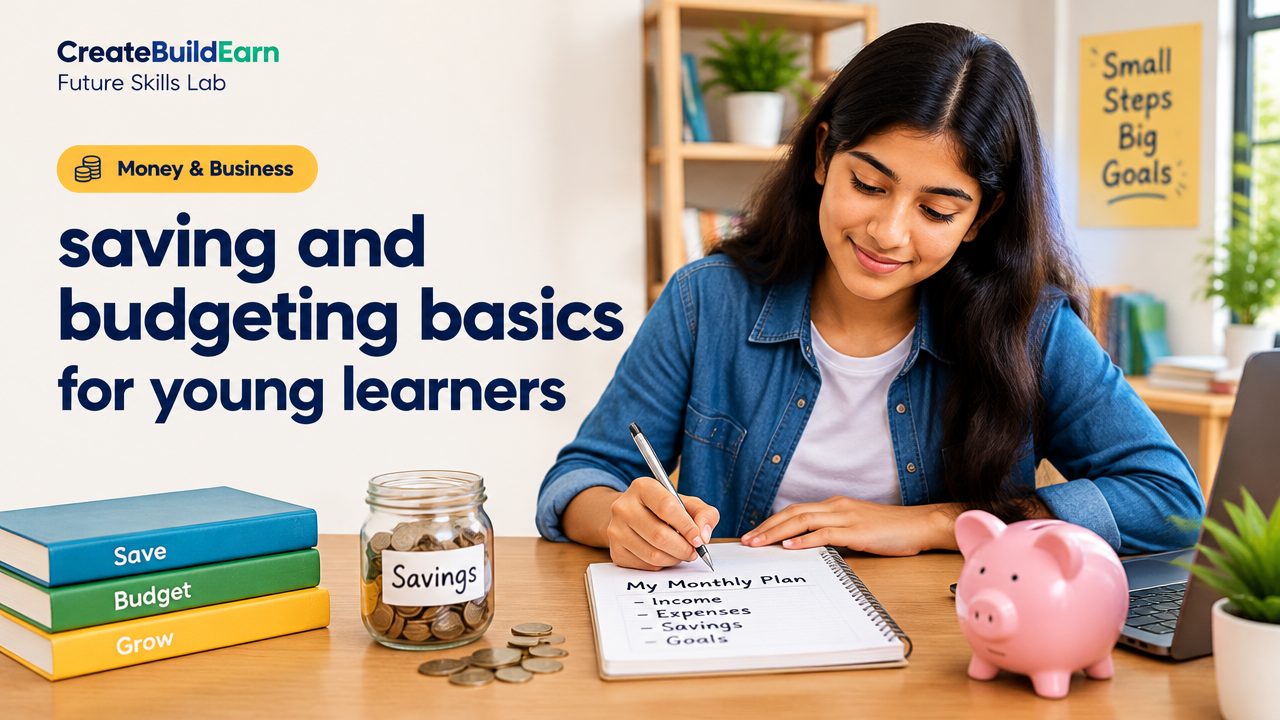
Quick Start
- What you will learn/build: Simple saving and budgeting plan, monthly budget template, basic cost/revenue/profit math.
- Skill level: Beginner — suitable for students and adult beginners.
- Time needed: 30–90 minutes (initial setup) + daily tracking for 1 month.
- What you need: Pen and notebook or a simple spreadsheet (Google Sheets or Excel), rough list of monthly income/pocket money and expenses, calculator or phone.
Introduction — Why saving and budgeting matter now
Learning to save and budget early helps you make choices, avoid avoidable stress and reach small goals like buying a gadget, paying for a course, or starting a simple side project. This guide explains the difference between saving and budgeting, shows how to track money, teaches basic cost/revenue/profit ideas, and gives a hands-on task you can complete in one month.
What is saving vs budgeting — simple definitions
Budgeting is a plan for how you will use your money. It lists income and expenses and helps you decide what to spend or save.
Saving means setting aside some money from income to use later. It can be for short goals (a month) or longer goals (6–12 months).
We also use three business words here: cost (what you spend to make or buy something), revenue (money you receive), and profit (revenue minus cost). For personal budgets, think of cost as expenses and revenue as pocket money, salary, allowances or small earnings.
Prerequisites — simple skills you need
- Basic addition and subtraction.
- Comfort reading small lists and writing short notes.
- Access to a phone or computer with a spreadsheet is helpful but optional.
Step-by-step path to a one-month budget
- List your income sources for the month (e.g., pocket money, part-time earnings).
- List fixed expenses (same every month) and variable expenses (changeable).
- Decide a savings goal (amount or percentage) for the month.
- Create a simple budget: Income − Savings = Available for expenses.
- Track expenses daily for the month and update the sheet once a week.
- At month end, calculate total spent, saved and any leftover.
Practical budget template (table)
| Item | Amount (INR) | Notes |
|---|---|---|
| Total Income | 0 | Pocket money, earnings, gifts |
| Planned Savings | 0 | Goal amount or % |
| Fixed Expenses | 0 | Subscriptions, transport |
| Variable Expenses | 0 | Food, outings, small buys |
| Available / (Leftover) | 0 | Income − (Savings + Fixed + Variable) |
Tip: Use a spreadsheet and put formulas so leftover updates automatically.
Worked example (INR) — 1-month pocket money
Rahul gets pocket money and does a small tutoring task one weekend. He plans a budget for the month.
- Total income: Pocket money = INR 1,500; Tutoring = INR 1,000. Total = INR 2,500.
- Planned savings: 20% of income = 0.20 × 2,500 = INR 500.
- Fixed expenses: Monthly phone recharge = INR 300.
- Variable expenses: snacks, travel, stationery = estimate INR 900.
Calculate leftover: 2,500 − (500 + 300 + 900) = INR 800 leftover.
If Rahul spends less on variable items (say INR 700), leftover becomes INR 900 or he can increase savings to meet a small goal.
Short explanation: cost, revenue, profit for small projects
If you sell a product or service (for example, handmade cards):
- Cost = price of paper, ink, envelopes, and any transport to sell.
- Revenue = money you receive from selling cards.
- Profit = Revenue − Cost. Profit shows if you made more money than you spent.
Keep record of cost and revenue for any small project so you know if it is worth continuing.
Try It Now / Mini Project
Mini Project: Create a one-month budget and track expenses for 30 days.
- Choose a period (e.g., this calendar month).
- Write down your expected income.
- Decide on one savings goal (INR amount or percentage).
- Track every expense daily. Use a notebook or spreadsheet.
- At week 2 and week 4, compare planned vs actual and adjust.
Optional challenge: Add a small micro-project (sell 10 handmade bookmarks). Track costs and sales, then calculate profit.
Checkpoint — Self-review after one month
- Did you meet your savings goal? (Yes / No)
- Were variable expenses higher or lower than expected?
- Do you have an action for next month (reduce snack spending, find small extra income)?
- Did you record costs and revenue for any micro-project? What was the profit?
Common mistakes and how to avoid them
- Not tracking day-to-day: Small buys add up. Record every expense.
- Unrealistic saving target: If 50% saving is impossible, start with 10–20%.
- Confusing wants with needs: Label items as must-have vs nice-to-have.
- No emergency plan: Keep a tiny buffer (even INR 200) for unexpected small costs.
- Ignoring business costs: When selling, include material and time cost to know true profit.
Review checklist (print or keep in your file)
| Checklist item | Done? |
|---|---|
| List of income written | |
| Savings goal set | |
| Fixed and variable expenses listed | |
| Daily tracking performed | |
| Month-end review completed |
Next practice — how to improve after your first month
- Try increasing savings by 5% if you met your goal.
- Experiment with a small side project and track profit. See Turn a Skill into a Freelance Service Ethically.
- Learn simple pricing and break-even ideas: Break-Even Units Explained and Pricing Digital Services.
- If you plan to use AI tools to help record or summarise expenses, follow the Student AI Privacy Checklist first.
Frequently Asked Questions
How much should a student save each month?
Start with a small, realistic amount like 10–20% of monthly income. Increase gradually if you can. The right percentage depends on your goals and essential expenses.
What counts as fixed vs variable expenses?
Fixed expenses are regular payments you can predict (e.g., monthly phone recharge). Variable expenses change week to week (e.g., snacks, outings). List both to create a reliable plan.
Can small earnings from online work be used for savings?
Yes. Treat those earnings as income and decide a portion to save. For minors, follow platform age rules and do not bypass identity or payment checks.
How do I price a small product I make?
Add all material costs and an hourly value for your time to get total cost. Then set a selling price above total cost to earn profit. Learn pricing steps in the linked pricing guide.
What if I run out of money before month end?
Review variable expenses and look for non-essential items to cut. Consider small, ethical short-term earners (tutoring, micro-tasks) and update next month’s budget to be safer.
Should I keep savings in a piggy bank or a bank account?
For small goals, a piggy bank is fine to start. For larger savings, a bank account under your or guardian’s name is safer. Follow bank age and documentation rules; do not bypass them.
Can I use a spreadsheet template?
Yes. Spreadsheets are recommended because formulas update totals automatically. A simple Google Sheet with Income, Savings, Fixed, Variable and Leftover columns works well.
Conclusion and next skill to learn
Budgeting and saving are practical, repeatable skills. Start with one realistic month of tracking, review results, and adjust. Next, learn about pricing and break-even to turn a hobby into a small, tracked project — see the Break-Even guide linked above. Keep records, set small goals and build the habit.
Useful next links: Break-Even Units Explained, Pricing Digital Services, Turn a Skill into a Freelance Service Ethically, Student AI Privacy Checklist.
Learn it by building something
Use the guide as a learning checklist, build a small version yourself, test it, explain what you learned and then improve the project.
How this guide was prepared
This guide is prepared for everyday readers using practical research, usability checks and editorial review. Product or tool-specific claims should be verified against current official documentation when needed.
How did you like this article?
Your feedback helps us make our guides more useful.

Join the Discussion
Join the conversation and share a useful tip, question or experience.