
Have you ever thought that one of your skills could actually help you earn money? Maybe you are good at writing, designing, editing videos, making websites, coding, drawing, using WordPress, or even managing social media. You may think these are just things you know how to do, but they can become useful services for other people.
The internet has made it much easier for people to offer their skills to clients. You do not always need a big office or a huge business to start. You mainly need a useful skill, some practice, a few examples of your work, and the patience to find your first clients.
Learning how to turn skills into income is a useful thing for anyone who wants to become independent in the future.
“A skill becomes valuable when it solves a real problem for someone.”
In this article, I will explain how you can take a skill you already have and turn it into a simple freelance service.
What Is Freelancing?
Freelancing means working for different clients without being a permanent employee of one company.
For example, imagine that you are good at making YouTube thumbnails. A YouTuber needs a new thumbnail for a video. You can offer to create the thumbnail for them for an agreed price.
The YouTuber gets the work done, and you get paid for your skill.
This is freelancing.
Freelancers can work in many areas, such as:
- Writing
- Graphic design
- Video editing
- Website design
- WordPress
- Coding
- Social media management
- Translation
- Data entry
- Presentation design
- Photo editing
- Voice work
- Digital marketing
You do not need to be perfect when you start. You just need to be good enough to provide something useful and keep improving.
Step 1: Find a Skill You Already Have
The first step is to look at what you can already do.
Do not immediately think about money. First, think about your abilities.
Ask yourself:
- What can I do better than a beginner?
- What do I enjoy doing?
- What do people usually ask me for help with?
- What software or tools do I know?
- What have I practiced for a long time?
- What skill would I like to improve?
For example, maybe you spend a lot of time editing videos. You may know how to cut clips, add music, add subtitles, create transitions, and make short videos.
That can become a video editing service.
Maybe you know WordPress. You could help someone set up a simple blog or fix basic website problems.
The important thing is to start with something you understand.
Step 2: Make Your Skill More Specific
One mistake beginners make is offering too many things at once.
Instead of saying:
“I can do everything.”
Try to offer one clear service.
For example:
- YouTube thumbnail design
- Short-form video editing
- Blog article writing
- WordPress setup
- Gaming video editing
- Logo design
- Social media post design
A specific service is easier for clients to understand.
Imagine someone needs a YouTube thumbnail. If your profile clearly says that you make YouTube thumbnails, they immediately understand what you can help with.
Step 3: Think About the Problem You Can Solve
A freelance service is not only about your skill.
It is about the problem your skill solves.
For example, a person may know how to edit videos. But a client may not have enough time to edit their own videos.
So the freelancer solves a time problem.
A website designer may help someone who does not know how to build a website.
A writer may help a business that needs regular blog posts.
A thumbnail designer may help a YouTuber who wants better-looking video thumbnails.
This is one of the most important parts of learning how to turn skills into income.
Instead of asking only:
“What can I do?”
Also ask:
“What problem can I solve?”
Step 4: Practice Before Looking for Clients
Before asking people to pay you, practice your skill.
You do not need hundreds of hours of practice before starting. But you should have enough practice to create decent work.
For example, if you want to become a thumbnail designer, make five or ten sample thumbnails.
If you want to become a video editor, create a few sample edits.
If you want to write articles, create sample blog posts.
These examples become your portfolio.
Your portfolio gives clients an idea of what you can do.
“Your portfolio is proof of your skill.”
You can improve your portfolio over time. Your first version does not have to be perfect.
Step 5: Create Sample Projects
You do not always need a real client to build a portfolio.
You can create your own sample projects.
For example, if you want to offer gaming video editing, take some gameplay footage and make a short edited video.
If you want to design websites, create a demo website.
If you want to write blog posts, write sample articles on topics you understand.
If you want to make thumbnails, create thumbnails for imaginary videos.
The goal is to show people what you can produce.
A strong sample can sometimes explain your ability better than a long description.
Step 6: Decide Who Your Service Is For
Now think about your target client.
You should have some idea about the people who may need your service.
For example:
Video editing: YouTubers, streamers, small businesses
Thumbnail design: YouTubers and gaming creators
WordPress: Bloggers, small businesses and website owners
Writing: Bloggers, websites and small businesses
Social media design: Creators and businesses
Knowing your target client makes it easier to create your service.
Instead of trying to reach everyone, you can focus on people who actually need what you offer.
Step 7: Create a Simple Service Package
Your service should be easy to understand.
For example:
Basic YouTube Thumbnail Service
- 1 thumbnail
- Custom design
- High-quality image
- One revision
You could also create larger packages later.
For example:
YouTube Thumbnail Package
- 5 thumbnails
- Custom designs
- Multiple revisions
- Different styles
Packages make it easier for clients to understand what they are getting.
You should clearly explain what is included and what is not included.
Step 8: Set a Reasonable Starting Price
Pricing can feel difficult when you are new.
You may wonder, “How much should I charge?”
There is no single price that works for every skill.
Your price can depend on:
- Your skill level
- Time required
- Difficulty of the project
- Quality of your work
- Client requirements
- Number of revisions
- Your experience
When starting, choose a price that feels reasonable for the amount of work you provide.
Do not promise a huge amount of work for a very small payment.
Also, do not make unrealistic income promises to clients.
As your experience and portfolio grow, you can review your prices.
Step 9: Create a Simple Portfolio
Your portfolio does not need to be complicated.
You can start with a simple page or document showing:
- Your name or brand name
- Your service
- A short introduction
- Your best work
- What you offer
- Your starting price, if you want to show it
- How people can contact you
Only show your best examples.
Five strong examples are often more useful than twenty weak ones.
Step 10: Find Your First Clients
Getting the first client is usually one of the hardest parts.
You may have the skill, but nobody knows about you yet.
You can start by telling people about your service.
Depending on your age and situation, you can use appropriate platforms with the required permissions and age rules.
You can also build connections with creators, small businesses, or people who may need your service.
Do not spam people.
Instead, write a short and polite message explaining what you do.
For example:
“Hi, I noticed you create gaming videos. I make gaming thumbnails and I would be happy to show you some examples of my work.”
Keep it simple.
Step 11: Learn How to Talk to Clients
Good communication is an important freelance skill.
Before starting a project, understand exactly what the client wants.
Ask about:
- The project
- The deadline
- Required format
- Style
- Size
- Important information
- Number of revisions
- Final delivery
Do not assume everything.
If something is unclear, ask politely.
Clear communication can prevent many problems later.
Read More: 7 Powerful Steps to Create a Social Media Content Strategy That Truly Connects
Step 12: Deliver Your Work on Time
When you accept a project, take the deadline seriously.
If you say you will deliver something on Friday, try to finish it on time.
If you face a genuine problem, communicate early instead of disappearing.
Being reliable can make a big difference.
A client may remember a freelancer who was easy to work with and delivered properly.
“Skill can get you noticed, but reliability can help people trust you.”
Step 13: Ask for Feedback
After completing work, look at what you could improve.
You can ask the client whether anything needs changing.
You should also review your own work.
Ask:
- Was the quality good?
- Did I understand the instructions?
- Did I finish on time?
- Was my communication clear?
- What can I improve next time?
Every project can teach you something.
Step 14: Keep Improving Your Skill
Freelancing does not mean you stop learning.
Tools and trends change all the time.
A video editor may learn new editing techniques.
A designer may learn new design tools.
A writer may learn better ways to structure articles.
A WordPress user may learn new website features.
Spend some time learning every week.
You do not have to learn everything at once.
Choose one improvement and practice it.
How to Turn Skills Into Income: A Simple Example
Let’s say you are good at making gaming thumbnails.
At first, your skill is simply:
“I can make thumbnails.”
Now turn it into a service:
Service: Gaming YouTube Thumbnail Design
Then create five sample thumbnails.
Next, create a simple portfolio.
Then decide what your package includes.
After that, start finding suitable clients.
When someone needs a gaming thumbnail, they can hire you.
This is the basic process of how to turn skills into income.
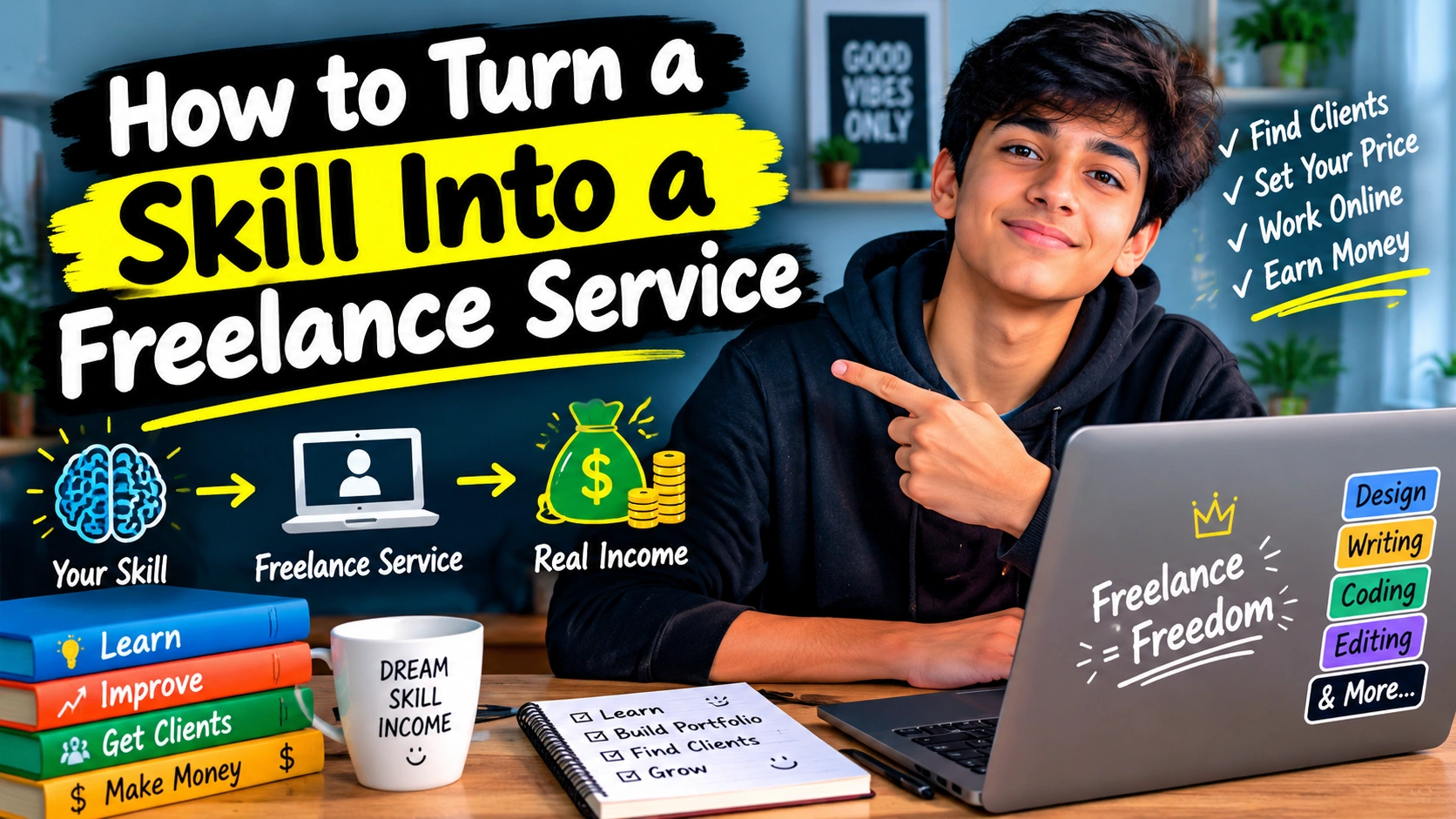
Skill → Service → Portfolio → Clients → Paid Work
It looks simple, but each step takes practice.
Important Information Before Starting Freelancing
If you are under 18, you should be especially careful when using freelance websites, payment services, contracts, or online marketplaces. Many services have age requirements or require a parent or guardian to manage accounts or payments.
Never share passwords, bank details, private documents, or other sensitive information with random people online.
Also be careful about scams.
If someone promises huge money for almost no work, asks you to pay money before receiving a job, or asks for unusual personal information, stop and check the situation with a trusted adult.
Quick Freelancing Information Table
| Area | What You Need | Simple Example |
|---|---|---|
| Skill | Something useful you can do | Editing videos |
| Service | A clear offer | Gaming video editing |
| Portfolio | Examples of your work | 3–5 sample edits |
| Client | Someone who needs the service | YouTube creator |
| Price | Reasonable payment for your work | Based on time and difficulty |
| Communication | Clear messages and questions | Confirm project details |
| Delivery | Finished work | Send the final video |
| Improvement | Learning from every project | Better editing next time |
| Safety | Protect personal information | Never share passwords |
| Growth | Improve skill and service | Add better editing styles |
Common Skills That Can Become Freelance Services
There are many skills you can turn into services.
Here are some simple examples:
| Skill | Possible Freelance Service | Example Client |
|---|---|---|
| Writing | Blog writing | Website owner |
| Editing | Video editing | YouTuber |
| Design | Thumbnail design | Gaming creator |
| Coding | Small website work | Small business |
| WordPress | Website setup | Blogger |
| Drawing | Digital artwork | Creator |
| Photography | Photo editing | Small business |
| Social media | Post design | Local business |
| Presentation | Slide design | Student or business |
| Research | Basic online research | Content creator |
The important thing is to choose something you can actually do well.
Mistakes Beginners Should Avoid
Starting freelancing can be exciting, but beginners can make some common mistakes.
Trying to Offer Everything
Do not say you are a writer, designer, coder, editor, marketer, photographer, and expert at everything if you are still learning.
Start with one or two skills.
Copying Other People’s Work
Use your own work in your portfolio.
Do not take another freelancer’s work and present it as your own.
Promising Too Much
Only promise what you can deliver.
If a project takes two days, do not promise that you can finish it in one hour just to get the client.
Ignoring Communication
Even good work can become difficult if communication is poor.
Read the instructions carefully and reply clearly.
Focusing Only on Money
Money is important, but your first projects can also help you build experience.
Think about improving your skill, portfolio, communication, and reliability.
How to Grow After Getting Your First Client
Your first client is only the beginning.
After completing a few projects, look for patterns.
Maybe clients keep asking for a particular type of work.
That can become your specialty.
For example, you may start with general video editing but discover that you enjoy editing gaming shorts.
You can then focus more on gaming short-form editing.
This can make your service easier to understand.
You can also improve your portfolio and slowly create better service packages.
How to Turn Skills Into Income in the Long Term
The long-term goal is not just to complete one project.
The goal is to build a useful skill that can continue helping you.
You can keep learning, build a stronger portfolio, improve your communication, and develop a good reputation.
Over time, your skill may open other opportunities too.
For example, a person who starts with video editing may later learn content creation.
Someone who starts with WordPress may later learn web development.
Someone who starts with writing may later learn SEO and content strategy.
One skill can lead to another.
That is why learning how to turn skills into income is not only about making money today. It is also about building useful abilities for the future.
A Simple Freelancing Plan for Beginners
If you want to start, you can follow this simple plan:
Day 1: Choose one skill.
Day 2: Decide what service you can offer.
Day 3: Study what clients may need.
Day 4–7: Create sample work.
Week 2: Build a simple portfolio.
Week 3: Improve your service description.
Week 4: Start looking for suitable clients safely.
Do not worry if everything does not happen perfectly.
The first goal is to learn.
FAQ for This Article
1. Can any skill become a freelance service?
Not every skill will immediately become a freelance service, but many useful skills can be turned into services when they solve a real problem for someone. Writing, editing, design, coding, WordPress, and many other skills can be offered as services.
2. Do I need experience to start freelancing?
You do not always need professional experience, but you should have enough practice to provide useful work. Creating sample projects is a good way to show what you can do before getting your first client.
3. How do I find my first freelance client?
Start by identifying people or businesses that may need your service. Build a small portfolio and introduce your service politely. Avoid spam and be careful with strangers, payments, and personal information.
4. How much should a beginner freelancer charge?
There is no fixed amount. Your price can depend on your skill, the difficulty of the project, the time required, and what you are delivering. Start with a reasonable price and review it as your skills and experience grow.
5. Can teenagers start freelancing?
Teenagers may be able to do certain types of freelance work, but online platforms and payment services can have age restrictions. Always check the rules and involve a parent or guardian where required.
Conclusion
Turning a skill into a freelance service may look difficult at first, but the basic idea is simple.
First, find a skill you can use. Then turn that skill into a clear service. Create some sample work, build a small portfolio, find suitable clients, communicate properly, and keep improving.
You do not need to know everything before starting.
You just need to start learning and practicing.
Your skill is the starting point. Your service is what you offer. Your portfolio shows what you can do. Your clients give your skill a real purpose.
If you are patient and keep improving, a skill that starts as a hobby can become something much more useful in the future.
So if you are wondering how to turn skills into income, start by looking at what you already know.
You might have a useful skill that you have never thought of as a service before.
“Start small, learn from every project, and keep getting better.”
That is how a simple skill can slowly become a freelance service.
Want a professional website designed for your business or blog?
Visit eDigitalized for website design and development services.
Need help or support?
Visit our Contact Us page and get in touch with us.
Want to become a blogger and start your own blog?
Visit WP Bazaar for blogging resources, tools, and helpful guides.

How this guide was prepared
This guide is prepared for everyday readers using practical research, usability checks and editorial review. Product or tool-specific claims should be verified against current official documentation when needed.
How did you like this article?
Your feedback helps us make our guides more useful.


Join the Discussion
Join the conversation and share a useful tip, question or experience.